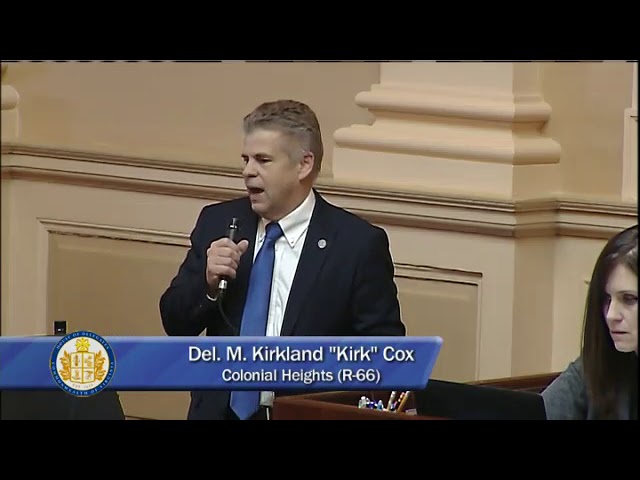
In a rare and highly-emotional point of personal privilege, Speaker of the Virginia House of Delegates Kirk Cox (R-Colonial Heights) stepped off the dais Wednesday afternoon to remark on one of the most shocking pieces of legislation to be considered by the General Assembly in recent memory.
On Tuesday, a Democratic legislator in the Virginia House of Delegates spoke about a bill she introduced in the 2019 General Assembly session that would lead the Commonwealth towards the ways of New York in repealing restrictions on abortion, including terminations up until the moment of birth.
H.B. 2491, patroned by Delegate Kathy Tran (D-Springfield), would repeal restrictions on third trimester abortions, allowing abortion doctors to self-certify the necessity of late term procedures, eliminate informed consent requirements, repeal abortion clinic health and safety standards, permit late term abortions to be performed in outpatient clinics, remove ultrasound requirements, and eliminate Virginia’s 24-hour waiting period.
Although the legislation was not expected to pass during this year’s session, it represents a progressive policy vision embraced by the leaders of Virginia’s Democratic Party, including Governor Ralph Northam, Lieutenant Governor Justin Fairfax, and Attorney General Mark Herring.
“I have been here almost 30 years,” Speaker Cox said, who relayed that he would be “delivering this speech from the same place I started…desk number 79.”
“A lot of you know I’m not the most spontaneous person in the world, and I’m not the most impulsive. I fully understand that this office comes with tremendous power. I fully understand that you must use that power wisely.”
“I know what I’m doing today. I know it’s a very big deal. This speech is about the number 61,012,997,” he said.
“That is, believe it or not, 50 times larger than all the men and women that have been lost to war in this country.”
“I gave a similar speech in 1996 when that number was 20 million. I gave another speech in 2000 and that number was 40 million. The last time I gave a speech in 2014, I know the number well. it was 54,600,549,” Speaker Cox relayed. “It is the number of abortions since 1973.”
“That number absolutely crushes me. That number absolutely overwhelms me. That number keeps me up at night,” he said, conveying great emotion.
Referencing Psalm 139, the speaker said, “You made all the delegator parts of my body. You knit me together in my mother’s womb. Thank you for making me so wonderfully complex. Your workmanship is marvelous. How well I know it. You watched me as I was being formed in utter seclusion as I was woven together in the dark of the womb. You saw me before I was born. Everyday of my life was recorded in your book. Every moment was laid out before a single day has passed.”
Referencing Hebrews 3:4, he added, “For every house has a builder, but the one that built everything is God.”
“Do you realize we’re made in the image of God?” Cox asked the House.
“One of [the] most astounding things, when I think about it, is the eye, because it’s the window on the whole world,” he said.
Continuing his floor speech, Cox added, “Your retina has 130 million rod-shaped cells, they detect light intensity…they transmit impulses to the brain by means of one million neuro-fibers. Those numbers are almost silly. How on Earth can a creator do that?”
“Nearby,” he added, “six million cone-shaped cells pick out color variation, and the one that amazes me the most, the eye can handle 500,000 messages, simultaneously.”
“We are no accident,” the speaker told the 99 other members of the House of Delegates.
“How about a baby?” he asked.
The speaker continued on, “Week four: The two optic nerves are forming the lens. Week eight: That retina I just began to talk about is forming. Week 16: The eye picks up light. Week 26: The end of the second trimester, that eye is fully formed and the eyelids open. And I think if you shine a flashlight on a mother’s stomach, you might just get a kick or a wiggle.”
“With the miracle of modern medicine, at 22 weeks, we [babies] now have a 20 percent survival rate,” he said. “What a blessing. Modern medicine…what would that be in five years, in 10 years, in 15 years, in 20 years?”
“On January the 22nd…I read the following headline – New York Passes Bill Expanding Abortion Access.”
“My heart just sank,” he remarked.
The bill allows women to seek abortions after a fetus is 24 weeks old if the mother’s life or health is threatened by the pregnancy, also making it legal for women to have an abortion at any time if the fetus is not viable. Moreover, abortion is moved to be regulated under public health law, rather than criminal law, and allows licensed nurse practitioners, physician assistants, and licensed midwives to conduct abortions.
New York Governor Andrew Cuomo (D) hailed the passage of the legislation as a “giant step forward.”
Following the development, the spire atop New York’s Freedom Tower, standing 1,776 feet above the ground, was lit bright pink in solidarity with the activists and lawmakers who helped push the monumental change.
“The freedom tower has two pools that mark 9/11,” Cox explained. “Around each is name of every person who was killed that day. Beside the names of 11 women, a carved stone says ‘and your unborn child.'”
The speaker then told a story about a woman he knows, named Monique, who works at the Capitol building. In 1995, her mother was expecting a third child when a doctor told her that the child would possibly be born with Down Syndrome, due to tests that were run.
“The doctor strongly suggested that she get an abortion,” Cox said about the woman’s mother, who then gave birth the girl, Monique.
The speaker explained that Monique said her mother had “powerful personal belief in life, and that was out of the question.”
“She chose to part ways with her doctor,” he said, “and to make a long story short, there were errors in the testing, false positives.”
“Monique, today, is a recently-graduated young woman of Mary Baldwin University working here at the Capitol, she is marrying her high school sweetheart in July, she’s headed to law school in the fall, she is grateful she told me that her parent’s convictions led them to choose life,” the speaker explained.
Monique was sitting in the House Gallery just one story above the lawmakers Wednesday afternoon. When Cox pointed her out, she received a standing ovation from most, but not all, of the delegates in quorum. Some Democrats chose to remain seated.
“I wish Governor Cuomo could hear Monique’s story,” Speaker Cox charged. “A lot of us think what happened in New York, is New York. So what does this have to do with Virginia?”
“Headline,” Cox continued, “January 27th – Northam Vows To Implement New York Version Of Abortion Law.”
Reading the first paragraph of the article, Cox recited, “Virginia Democratic leaders backed legislation repealing restrictions on third trimester late term abortions, repealing clinic health and safety standards, and eliminating informed consent requirements, among other provisions. They noted the measures were unlikely to pass in 2019, but Governor Northam vowed,” “words have meaning,” he added, “if Democrats take the Virginia House and Senate in November’s elections.
“Here’s what that means,” he set to explain, “this bill will allow a mother showing physical signs of labor to get an abortion.”
“We are really one small step from New York,” the speaker added.
“Did anyone in New York give a speech? Did anyone sound the alarm? Did anyone get out of their comfort zone to stop this? Where have I been since 2014? How did I ever let five years slip away without really doing anything?” Cox proclaimed.
“Here’s how…I made speeches numerous times, and I thought to myself ‘I’ve done my part.’ Every time I do that speech it’s controversial, it makes people extremely unconformable, they’re squirming, they’re staring at the floor, ‘let someone else do it,'” he said. “After all, especially now, ‘you’re the speaker, you’re an important guy, this is a really sensitive topic.””
“You know, those are excuses,” he said. “Those are weaknesses, and I feel ashamed.
“So let’s go full circle,” Speaker Cox continued, “It’s good I’m here in this seat today, seat number 79. I vowed in 1990 to do everything I could to save the unborn and protect life. Frankly, my record has been spotty at best. This speech only begins the true fulfillment of that promise to myself. Promise – reflect on that word. Words have meaning.”
“It reflects not only my commitment to myself, it also reflects the quality of potential – what could be,” he added.
“There are 61,012,997 unkept promises. There are 61,012,997 Moniques who never got to marry their high school sweetheart, never went to college, never went to law school, never go to work at Thomas Jefferson’s capital,” he said.”
“So what is my promise?” Cox posited.
“I will never stop fighting for the promise of life as long as I hold a gavel, as long as I can speak into this microphone, as long as I have the privilege of this floor. I promise to fight for the promise of life.”